

 Document
TennCare Networking Reporting Reform Act Leave Behind

Document
The Freedom For Family Care Act – Leave Behind for Legislators

Document
Strategies for Moving Forward Together: Return to School Series Resources
Impact of the Pandemic on Families
Intersections of Mental Health and Suicide
Building Resiliency through Brain Health
Putting the Pieces Together: Panel and Q&A

Document
2025 Brain Links’ Webinar Training Series
People with brain injury often seek treatment for multiple co-occurring needs, like substance use disorder, mental health, domestic violence and/or chronic pain. The brain injury must be properly identified, and symptoms must be accommodated to enable the person to fully benefit from support programs in these and other areas.
Each session in this series will use case studies with different levels of injury, individual challenges and interactions with systems. We will also show how to apply existing tools when working to support the individual.
Document
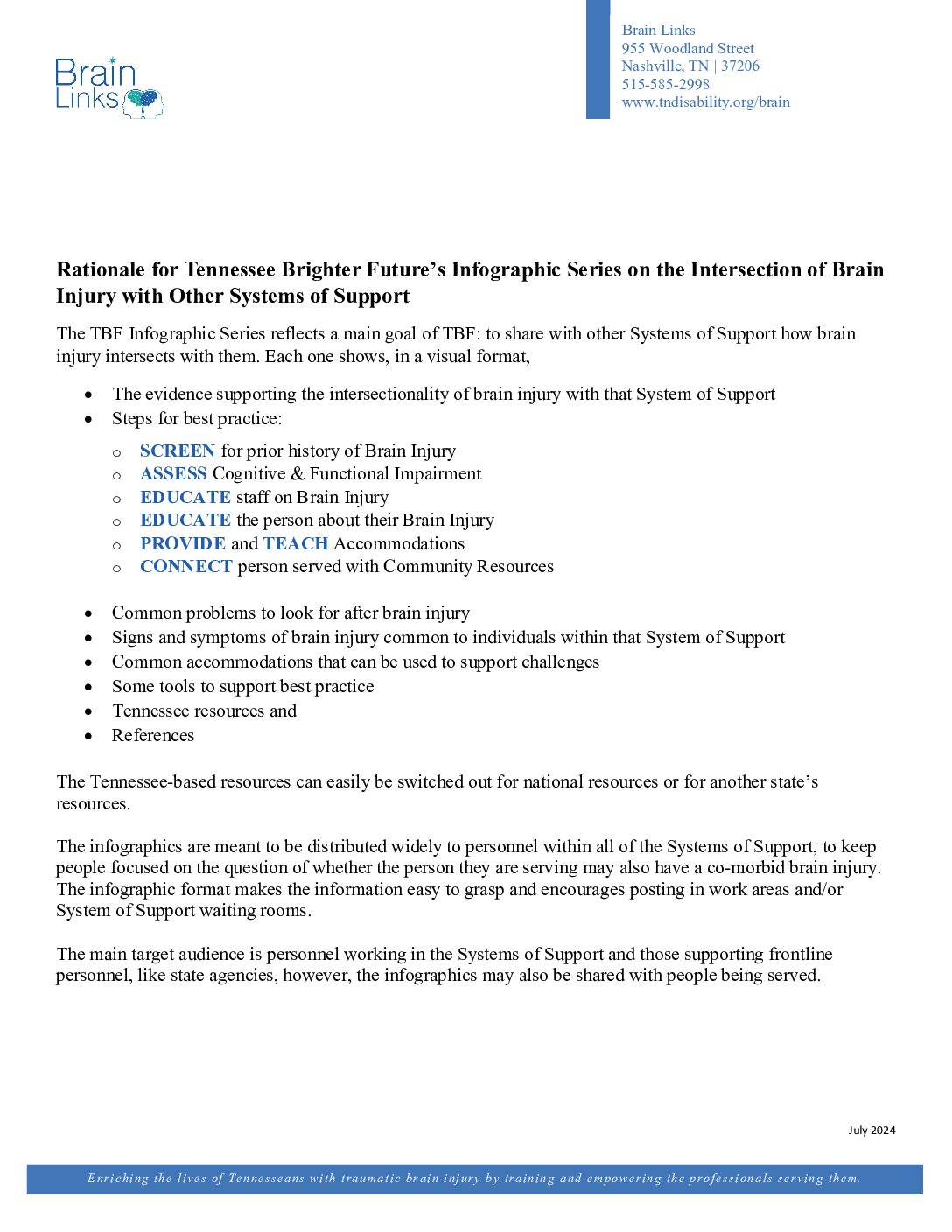
Rationale for Tennessee Brighter Future’s Infographic Series on the Intersection of Brain Injury with Other Systems of Support

Document
Substance Use Disorder Resources
Intersectionality with Brain Injury:
After brain injury, 70-80% are discharged from healthcare facilities with a prescription for opioids.
People with traumatic brain injury are ten times more likely to die of accidental overdose, in larger part because of cognitive and behavioral changes.
Within 8-12 months after injury, 10-20% will develop a substance use problem and that number will grow over time.
Approximately half of people receiving substance use treatment have at least one brain injury.
As high as 75% of people seeking both mental health and substance use treatment also have a brain injury.
Twenty-five percent of people entering brain injury rehabilitation are there as a result of drugs or alcohol and being intoxicated at the time of injury makes it harder for the brain to heal.
Those with childhood TBI are more likely to use drugs and alcohol as adults.
For every overdose death, there are approximately fifty overdose survivors, 90% of whom become impaired because of insufficient oxygen to the brain.

Document
Chronic Pain Resources

Document
Domestic Violence Resources 2025
Intersectionality with Brain Injury
As many as 20 million women each year could have a traumatic brain injury caused by domestic violence. The head, neck and face are common targets of intimate partner assaults. Women who are abused are more likely to have repeated injuries to the head. Brain injuries often go undetected and untreated because women are more likely to seek shelter than treatment. (St. Ivany, Bullock, et al. 2018)
Document
Recording & PowerPoint_TBF: Juvenile Justice
January 4, 2024 Presenter:
Linda Copeland, MS, Youth Justice Director, Tennessee Commission on Children & Youth
Juvenile Justice is a system of laws, policies, and procedures intended to regulate the processing and treatment of nonadult offenders for violations of law and to provide legal remedies that protect their interests in situations of conflict or neglect.
Document
ACEs – TBF Resources Pages_txt
Adverse childhood experiences (ACEs) are stressful or traumatic events, including abuse and neglect. They may also include household dysfunction such as witnessing domestic violence or growing up with family members who have substance use disorders. ACEs are strongly related to the development and prevalence of a wide range of health problems throughout a person’s lifespan, including those associated with substance misuse.

Document
Mental Health & Suicide Prevention Resource Pages
About Mental Health
Millions of people in the U.S. are affected by mental illness each year.
• 1 in 5 U.S. adults experience mental illness each year
• 1 in 20 U.S. adults experience serious mental illness each year
• 1 in 6 U.S. youth aged 6-17 experience a mental health disorder each year
• 50% of all lifetime mental illness begins by age 14, and 75% by age 24
• Suicide is the second leading cause of death among people aged 10-14

Document
2025 Suicide Report Infographic
Tennessee Department of Health: Suicide Prevention in Tennessee 2025 Annual Report